Roman Imperial Palace, Milan
Roman Site in Milan
The Roman imperial palace of Milan once formed the beating political heart of Mediolanum, the capital of the Western Roman Empire from 286 to 402 AD. Built and embellished by Emperor Maximian, this sprawling complex was far more than a residence: it was a self-contained city of power, filled with audience halls, administrative quarters, private baths, military garrisons, places of worship, and residential districts. Today, the palace itself has vanished, but its memory survives in scattered archaeological sites, street layouts, and evocative place names. Exploring this area offers a very different side of Milan, and for history lovers it's one of the best places to visit in Milan if you want to imagine the city as an imperial capital.
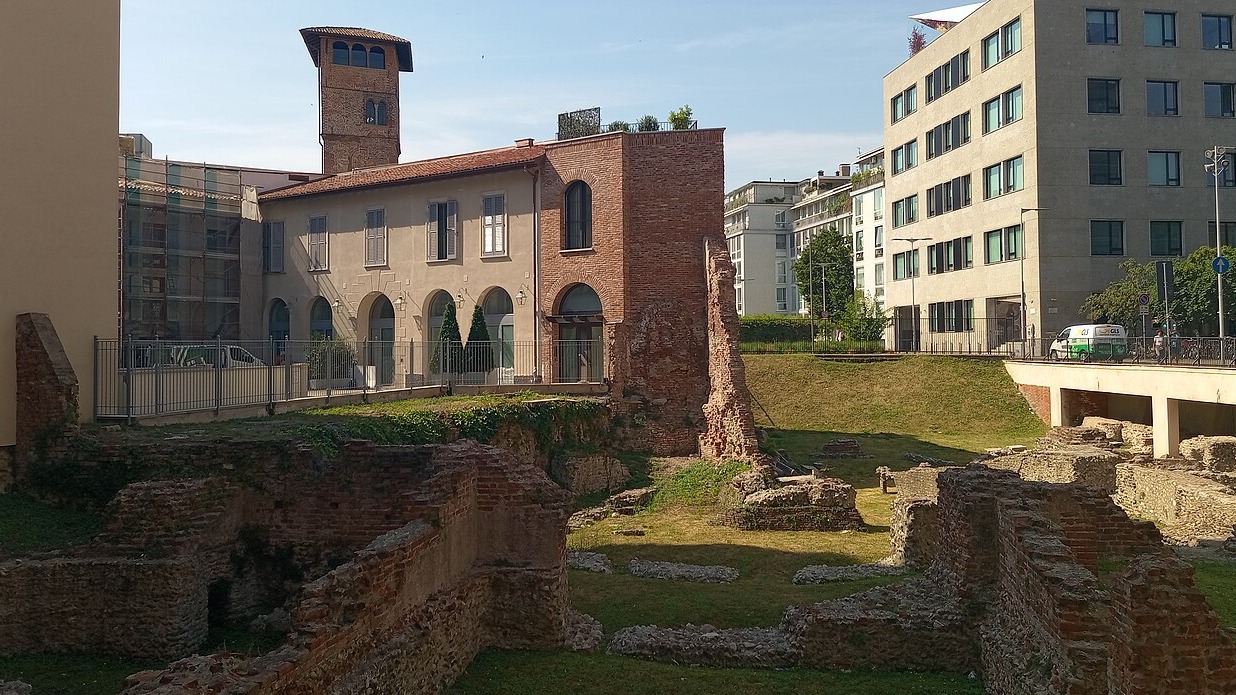
Unlike a single, enclosed monument, the Roman imperial palace district is a network of locations layered into the modern city, especially around Via Brisa, Via Gorani, Piazza Borromeo, and the streets between Corso Magenta and Via Torino. Excavations carried out between 1951 and 1962 uncovered foundations, stretches of wall, decorated floors, and traces of grand porticoed courtyards. The open-air remains along Via Brisa are particularly accessible, while the church of San Giorgio al Palazzo preserves the palace's memory in its very name. Walking these streets, often visited on walking tours of Milan, you can trace the outlines of the ancient Cardo and Decumanus and picture the palace that once linked directly to the circus via a covered passage reserved for the emperor.
Table of Contents
- History and Significance of the Roman Imperial Palace in Milan
- Things to See and Do in the Roman Imperial Palace District
- How to Get to the Roman Imperial Palace in Milan
- Practical Tips on Visiting the Roman Imperial Palace in Milan
- Where to Stay close to the Roman Imperial Palace in Milan
- Is the Roman Imperial Palace in Milan Worth Visiting?
- FAQs for Visiting the Roman Imperial Palace in Milan
- Nearby Attractions to the Roman Imperial Palace in Milan
History and Significance of the Roman Imperial Palace in Milan
When Emperor Maximian chose Mediolanum as the capital of the Western Roman Empire in 286 AD, the city had to be reshaped to reflect its new status. A huge portion of the western side of the urban area was devoted to the imperial palace and its surroundings, forming a district known in sources as the palatium or regia. This was not just a grand home but the nerve centre of imperial administration, diplomacy, and ceremony, where officials, soldiers, courtiers, and petitioners moved through a carefully choreographed world of power.
As in other imperial capitals, Maximian’s palace was planned with direct access to the circus so that he could attend games and spectacles without mixing with the crowds. Mediolanum’s complex included a covered passage linking the palace to the Roman circus, a potent symbol of the emperor’s status above ordinary citizens. Over time, the district expanded to incorporate private baths, service buildings, worship spaces, and residences for those who serviced and surrounded the court, transforming this part of the city into a high-security enclave of elite life.
The palace’s story did not end with the fall of the Western Empire. It continued to function in various forms through the Gothic and Lombard periods, but between the end of Lombard rule and the first half of the 10th century it gradually fell into disuse. By the end of that century it had been demolished, its stones reused, its courtyards built over. Only the urban footprint and certain structures-like the polygonal and square towers that once formed part of the Maximian walls and hippodrome-hinted at what had been. The later church of San Giorgio al Palazzo, founded in the 12th century, preserves the palace’s memory in its name, marking a site that once lay inside the imperial district.
Things to See and Do in the Roman Imperial Palace District
Visiting the Roman imperial palace in Milan today means piecing together a puzzle across several streets and small sites rather than entering a single monumental complex. A good starting point is Via Brisa, where the most accessible remains form a small open-air archaeological area. Here you can see substantial stretches of wall and foundations, giving you a sense of the scale and solidity of the original structures. Standing among these ruins, with modern buildings rising around them, is a striking reminder of how thoroughly the city has layered new eras over old.
From Via Brisa, wander towards Via Gorani and Piazza Borromeo, where excavations have revealed traces of porticoed courtyards that once formed part of the palace’s architectural core. These arcaded spaces would have framed gardens, processional routes, or reception areas, offering shade and grandeur in equal measure. As you walk, try to imagine the complex alive with officials, guards, and attendants moving between audience halls and living quarters, while the emperor could slip along the covered passage to the circus to watch races and spectacles unseen by the crowds.
Pay attention, too, to the street grid. The ancient Decumanus Maximus corresponds roughly to today's Via Santa Maria Fulcorina, while Via Torino follows the line of the Cardo Maximus between the former Porta Romana Ticinese and Porta Vercellina. Even without extensive standing remains, this grid helps you reconstruct the Roman city plan in your mind. Finally, a stop at the church of San Giorgio al Palazzo on Piazza San Giorgio al Palazzo offers a later, medieval and Baroque layer of history on a site whose very name echoes the imperial palatium that once stood nearby. This spot is one of the must-see places in Milan if you enjoy using your imagination to rebuild lost worlds from subtle clues.
How to Get to the Roman Imperial Palace in Milan
The Roman imperial palace district lies in central Milan, roughly between Corso Magenta, Via Santa Maria alla Porta, Via Santa Maria Fulcorina, and Via Torino, within easy walking distance of the Duomo, Sant'Ambrogio, and the Duomo Museum. Most international visitors arrive via Milan Malpensa, Milan Linate, or Orio al Serio (Bergamo) airports, all of which offer shuttle buses, trains, and taxis into Milan's main railway stations and central districts. For the best deals and a seamless booking experience, check out these flights to Milan on Booking.com.
Once in the city, you can reach the area easily by metro, tram, or bus. Stations around Duomo, Cordusio, Cadorna, or Sant'Ambrogio put you close enough to walk to Via Brisa, Via Gorani, and Piazza Borromeo, following a route that also takes in other historic churches and palazzi.Use Omnio to easily compare schedules, book train tickets, and find the best prices all in one place for a hassle-free journey across Italy. The district is compact, so the best way to explore is on foot, allowing you to link the various sites and read the modern city against the outlines of ancient Mediolanum.
If you are travelling by car, remember that this part of Milan sits inside limited traffic and congestion-charge zones, and parking is scarce and expensive.If you are looking to rent a car in Italy I recommend having a look at Discover Cars, first, as they compare prices and review multiple car rental agencies for you. It is generally more convenient to park in a garage outside the tightest central area and continue on foot or by public transport, which also lets you enjoy the historic streets without worrying about traffic restrictions.
Practical Tips on Visiting the Roman Imperial Palace in Milan
- Suggested tips: Bring or download a simple map marking Via Brisa, Via Gorani, Piazza Borromeo, and San Giorgio al Palazzo so you can connect the dots between the scattered remains.
- Best time to visit: Daytime hours on weekdays or quiet weekend mornings are ideal for exploring the area at your own pace and taking photos without crowds.
- Entrance fee:
- Opening hours:
- Official website:
- How long to spend: Allow 1-2 hours to walk between the key streets, examine the remains, and stop at San Giorgio al Palazzo or nearby churches.
- Accessibility: Street-level remains are generally accessible, though some archaeological areas may have steps, uneven surfaces, or railings; suitable footwear is recommended.
- Facilities: There are no dedicated visitor facilities on-site; use cafés, shops, and restrooms in the surrounding central streets.
- Photography tip: Aim for close-ups of masonry, brickwork, and surviving decorative floors, and try framing ruins against modern buildings to emphasise the contrast between Roman and contemporary Milan.
- Guided tours: Consider joining a Roman Milan walking tour or hiring a local guide who can interpret the fragmentary remains and help you visualise the original palace complex.
- Nearby food options: The surrounding area between Corso Magenta, Via Torino, and towards the Duomo is full of cafés, bakeries, and trattorias where you can take a break after your historical walk.
Where to Stay close to the Roman Imperial Palace in Milan
Staying near the Roman imperial palace district puts you within easy reach of both the Duomo and Corso Magenta, ideal for exploring ancient, medieval, and Renaissance Milan in one go. For a historic-feeling base close to Corso Magenta and key churches, Hotel Palazzo delle Stelline offers peaceful cloisters and a convenient central location. If you prefer to be slightly closer to the Duomo and Via Torino, Rosa Grand Milano - Starhotels Collezione provides comfortable rooms just a short walk from the cathedral and the palace district. Another good option is UNA Hotel Cusani Milano, which sits between Castello Sforzesco and the city centre, making it easy to reach the Roman sites, the castle, and Brera on foot.
Is the Roman Imperial Palace in Milan Worth Visiting?
The Roman imperial palace in Milan is absolutely worth seeking out if you enjoy archaeology, urban history, and using a bit of imagination. Although no single monumental structure survives, the scattered walls, foundations, and courtyard traces offer a fascinating glimpse of Mediolanum when it served as capital of the Western Roman Empire. Walking the lines of the ancient Cardo and Decumanus, visiting the open-air remains at Via Brisa, and ending at San Giorgio al Palazzo turns this part of the city into a kind of open-book history lesson. For many visitors, it becomes one of the most memorable places in Milan precisely because it is subtle, layered, and still embedded in the living fabric of the modern city.
FAQs for Visiting the Roman Imperial Palace in Milan
Where exactly are the remains of the Roman imperial palace located?
They are spread across several central streets, mainly around Via Brisa, Via Gorani, Piazza Borromeo, and the area between Corso Magenta and Via Torino, which follow the lines of the ancient Decumanus and Cardo.
Is there a single entrance or visitor centre for the palace?
No, this is an open urban archaeological area rather than a single site; some remains are integrated into the streetscape, while others form small open-air museum spaces.
Can I visit the area independently without a guide?
Yes, you can explore the streets and visible remains on your own, though a map or self-guided route helps; a guide can add depth if you want detailed historical context.
Is the Roman imperial palace suitable for children?
Older children with an interest in Romans or archaeology may enjoy spotting ruins around the streets, especially if you frame it as a kind of “treasure hunt”; younger kids may appreciate a shorter, more playful walk.
Nearby Attractions to the Roman Imperial Palace in Milan
- San Giorgio al Palazzo: A historic church whose name preserves the memory of the old palace and which adds medieval and later layers to the area’s story.
- Civic Archaeological Museum of Milan: Housed in the former Monastero Maggiore, with Roman and early medieval collections that complement a visit to the imperial district.
- San Maurizio al Monastero Maggiore: A richly frescoed church often called Milan's “Sistine Chapel,” located a short walk away on Corso Magenta.
- Castello Sforzesco and Parco Sempione: A medieval and Renaissance fortress complex with museums and a large park, offering another perspective on Milanese power centres.
- Milan Cathedral (Duomo di Milano): The city's Gothic landmark and its surrounding museums, easily reachable on foot and a striking contrast to the Roman imperial remains.
The Roman Imperial Palace appears in our Complete Guide to Visiting Milan!
This website uses affiliate links which may earn a commission at no additional cost to you!
Visiting Roman Imperial Palace
Nearby Attractions
- Chiesa di San Maurizio al Monastero Maggiore (0.1) km
Church - Civico Museo Archeologico (0.2) km
Historic Site and Museum - Pinacoteca Ambrosiana (0.4) km
Gallery - Castello Sforzesco (0.6) km
Castle - Galleria Vittorio Emanuele II (0.7) km
Shopping Centre - Teatro alla Scala (0.7) km
Theatre - Leonardo da Vinci's Last Supper (0.8) km
Church - San Lorenzo Basilica (0.8) km
Basilica - Parco Sempione (0.8) km
Gardens - Museo della Scienza e della Tecnologia "Leonardo da Vinci" (0.8) km
Museum